Nutritional Vulnerability among Children in Fishermen Households in Indonesia
A Secondary Analysis of SSGI 2024
DOI:
https://doi.org/10.62012/gh7hxw76Keywords:
Child Malnutrition, Fishermen Households, Stunting, Underweight, Wasting, SSGI 2024, Indonesia, Public NutritionAbstract
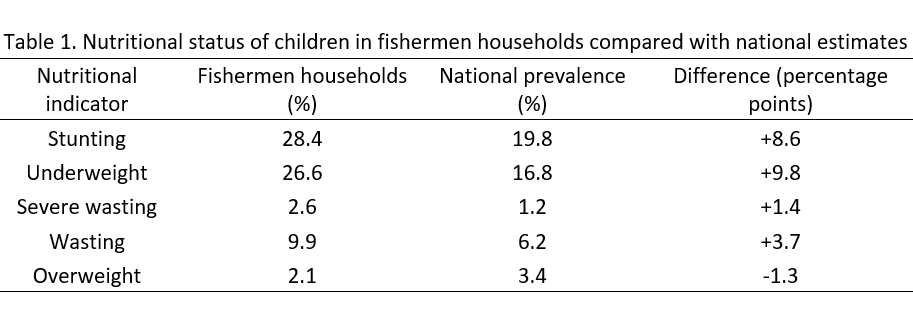
Child malnutrition remains a major public health challenge in Indonesia and may be unequally distributed across household livelihood groups. Fishermen households are an important population group in coastal and island communities, but their children may still experience nutritional vulnerability despite proximity to fishery resources. This study aimed to describe the nutritional status of children under five living in fishermen households in Indonesia using the 2024 Indonesian Nutritional Status Survey (Survei Status Gizi Indonesia, SSGI). This study used a descriptive secondary analysis of aggregated data published in the SSGI 2024 report. The analysis focused on nutritional indicators by occupation of the household head, particularly fishermen households. The indicators included stunting, underweight, severe wasting, wasting, and overweight. Children in fishermen households represented 2.1% of the under-five population reported in the SSGI characteristics table, corresponding to 12,231 children. The prevalence of stunting among children in fishermen households was 28.4%, higher than the national prevalence of 19.8%. Underweight was also higher in fishermen households at 26.6%, compared with the national prevalence of 16.8%. Severe wasting and wasting were 2.6% and 9.9%, respectively, while overweight was 2.1%. These findings indicate that children in fishermen households experience a higher burden of chronic and acute undernutrition than the national average. Nutrition programs should pay greater attention to coastal and fisheries-based households by integrating growth monitoring, dietary improvement, health service access, and household-level nutrition education.
Downloads
References
[1] Kementerian Kesehatan Republik Indonesia, Survei Status Gizi Indonesia 2024 dalam Angka. Jakarta, Indonesia: Kementerian Kesehatan RI, 2025.
[2] World Health Organization, WHO Child Growth Standards: Length/Height-for-Age, Weight-for-Age, Weight-for-Length, Weight-for-Height and Body Mass Index-for-Age: Methods and Development. Geneva, Switzerland: WHO, 2006.
[3] UNICEF, WHO, and World Bank Group, Levels and Trends in Child Malnutrition: UNICEF/WHO/World Bank Group Joint Child Malnutrition Estimates, 2025 Edition. New York, NY, USA: UNICEF, 2025.
[4] UNICEF, UNICEF Nutrition Strategy 2020–2030: Nutrition, for Every Child. New York, NY, USA: UNICEF, 2020.
[5] World Health Organization, Guideline: Assessing and Managing Children at Primary Health-Care Facilities to Prevent Overweight and Obesity in the Context of the Double Burden of Malnutrition. Geneva, Switzerland: WHO, 2017.
[6] Sekretariat Wakil Presiden Republik Indonesia, National Strategy to Accelerate Stunting Prevention 2018–2024. Jakarta, Indonesia: Sekretariat Wakil Presiden RI, 2018.
[7] UNICEF Indonesia, Formative Evaluation of the National Strategy to Accelerate Stunting Prevention. Jakarta, Indonesia: UNICEF Indonesia, 2024.
[8] R. E. Black et al., “Maternal and child undernutrition and overweight in low-income and middle-income countries,” The Lancet, vol. 382, no. 9890, pp. 427–451, 2013.
[9] C. G. Victora et al., “Revisiting maternal and child undernutrition in low-income and middle-income countries: Variable progress towards an unfinished agenda,” The Lancet, vol. 397, no. 10282, pp. 1388–1399, 2021.
[10] D. Headey, K. Hirvonen, and J. Hoddinott, “Animal sourced foods and child stunting,” American Journal of Agricultural Economics, vol. 100, no. 5, pp. 1302–1319, 2018.
[11] H. Asare, M. Rosi, L. Faber, and C. Smuts, “Animal-source foods as a suitable complementary food for improved physical growth in 6- to 24-month-old children in low- and middle-income countries: A systematic review and meta-analysis,” British Journal of Nutrition, 2022.
[12] K. A. Byrd, S. Pincus, S. Pasqualino, and C. D. Thilsted, “Fish and fish-based products for nutrition and health in the first 1000 days: A systematic review of the evidence from low- and middle-income countries,” Advances in Nutrition, 2022.
[13] L. L. Iannotti, C. D. Thilsted, R. S. Headey, and P. Webb, “Aquatic animal source foods for nutrition security and child health,” Food and Nutrition Bulletin, 2022.
[14] V. Miller et al., “Children’s and adolescents’ rising animal-source food intakes in the global diet transition,” Nature Food, vol. 4, pp. 302–313, 2023.
[15] Food and Agriculture Organization of the United Nations, IFAD, UNICEF, WFP, and WHO, The State of Food Security and Nutrition in the World 2025. Rome, Italy: FAO, 2025.
[16] Food and Agriculture Organization of the United Nations, The State of World Fisheries and Aquaculture 2024: Blue Transformation in Action. Rome, Italy: FAO, 2024.
[17] R. H. Nurrizka, R. H. Pradana, and R. S. Putri, “Indonesian under five years of age children’s malnutrition: The role of socioeconomic and environmental factors among fishermen community in Jakarta Bay, Indonesia,” in Proceedings of the International Conference on Social Sciences, 2020.
[18] S. Sumarmi, A. P. Mahmudiono, and T. M. Nadhiroh, “Household food insecurity and undernutrition in children below five years living in different geographical areas in East Java, Indonesia,” Malaysian Journal of Nutrition, 2018.
[19] F. Muchtar, S. Rejeki, and R. H. Sari, “Stunting in coastal communities in Indonesia: A review,” Public Health of Indonesia, 2023.
[20] J. Darni, Y. Solihati, and R. A. Pratiwi, “Assessing food security among fisher households in the coastal areas of Indonesia,” Nutrition, Clinical Dietetics and Hospital Dietetics, 2025.