Triple Burden Trends among Indonesian Children Under Five
Stunting, Wasting, and Overweight from 2013 to 2024
DOI:
https://doi.org/10.62012/a8nds813Keywords:
Child Malnutrition, Stunting, Wasting, Overweight, Triple Burden, Indonesia, SSGI, RiskesdasAbstract
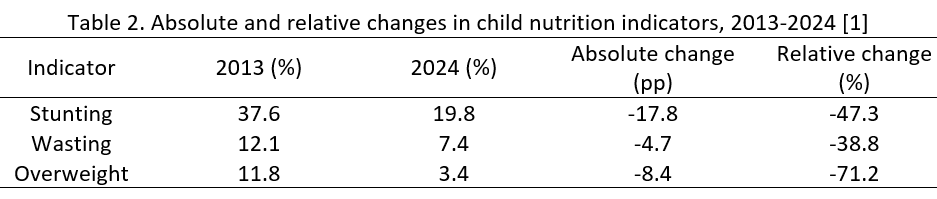
Indonesia has made sustained progress in reducing child malnutrition, yet the coexistence of stunting, wasting, and overweight remains an important concern for child nutrition policy. This study aimed to describe national trends in the triple burden of malnutrition among Indonesian children under five from 2013 to 2024 using secondary data from UNICEF Indonesia's Update Gizi Volume 6, April-June 2025, and related national nutrition sources. A secondary descriptive analysis was conducted using aggregate prevalence values for stunting, wasting, and overweight presented in the UNICEF trend chart, which compiles data from Riskesdas 2013 and 2018 and SSGI 2019, 2021, 2022, 2023, and 2024. The results showed that stunting declined from 37.6% in 2013 to 19.8% in 2024, representing an absolute reduction of 17.8 percentage points. Wasting decreased from 12.1% to 7.4%, although the trend fluctuated after 2021. Overweight declined from 11.8% to 3.4%, showing the largest relative reduction among the three indicators. Despite this progress, stunting remained below but close to 20%, wasting returned to the same level as 2019, and overweight continued to coexist with undernutrition. The findings indicate that Indonesia's child nutrition agenda should continue to address multiple forms of malnutrition simultaneously through integrated interventions involving maternal and child nutrition, complementary feeding, acute malnutrition management, healthy food environments, and continuous surveillance.
Downloads
References
[1] UNICEF Indonesia, Update Gizi Indonesia, Jilid 6: April-Juni 2025. Jakarta, Indonesia: United Nations Children's Fund, 2025.
[2] Kementerian Kesehatan Republik Indonesia, Survei Status Gizi Indonesia 2024 dalam Angka. Jakarta, Indonesia: Kementerian Kesehatan RI, 2025.
[3] Kementerian Kesehatan Republik Indonesia, Riset Kesehatan Dasar 2013. Jakarta, Indonesia: Badan Penelitian dan Pengembangan Kesehatan, 2013.
[4] Kementerian Kesehatan Republik Indonesia, Laporan Nasional Riskesdas 2018. Jakarta, Indonesia: Badan Penelitian dan Pengembangan Kesehatan, 2019.
[5] Kementerian Kesehatan Republik Indonesia, Buku Saku Hasil Studi Status Gizi Indonesia (SSGI) 2021. Jakarta, Indonesia: Kementerian Kesehatan RI, 2021.
[6] Kementerian Kesehatan Republik Indonesia, Survei Kesehatan Indonesia (SKI) 2023 dalam Angka. Jakarta, Indonesia: Kementerian Kesehatan RI, 2024.
[7] World Health Organization, WHO Child Growth Standards: Length/Height-for-Age, Weight-for-Age, Weight-for-Length, Weight-for-Height and Body Mass Index-for-Age: Methods and Development. Geneva, Switzerland: WHO, 2006.
[8] UNICEF, WHO, and World Bank Group, Levels and Trends in Child Malnutrition: UNICEF/WHO/World Bank Group Joint Child Malnutrition Estimates, 2025 Edition. New York, NY, USA: UNICEF, 2025.
[9] UNICEF, UNICEF Nutrition Strategy 2020, 2030: Nutrition, for Every Child. New York, NY, USA: UNICEF, 2020.
[10] World Health Organization, Guideline for Complementary Feeding of Infants and Young Children 6, 23 Months of Age. Geneva, Switzerland: WHO, 2023.
[11] World Health Organization, Guideline: Assessing and Managing Children at Primary Health-Care Facilities to Prevent Overweight and Obesity in the Context of the Double Burden of Malnutrition. Geneva, Switzerland: WHO, 2017.
[12] World Health Organization, WHO Guideline on the Prevention and Management of Wasting and Nutritional Oedema (Acute Malnutrition) in Infants and Children under 5 Years. Geneva, Switzerland: WHO, 2023.
[13] Sekretariat Wakil Presiden Republik Indonesia, Strategi Nasional Percepatan Pencegahan Anak Kerdil (Stunting) 2018, 2024. Jakarta, Indonesia: Sekretariat Wakil Presiden RI, 2018.
[14] R. E. Black et al., “Maternal and child undernutrition and overweight in low-income and middle-income countries,” The Lancet, vol. 382, no. 9890, pp. 427, 451, 2013.
[15] M. de Onis and F. Branca, “Childhood stunting: A global perspective,” Maternal & Child Nutrition, vol. 12, no. S1, pp. 12, 26, 2016.
[16] C. P. Stewart, L. Iannotti, K. G. Dewey, K. F. Michaelsen, and A. W. Onyango, “Contextualising complementary feeding in a broader framework for stunting prevention,” Maternal & Child Nutrition, vol. 9, no. S2, pp. 27, 45, 2013.
[17] Z. A. Bhutta et al., “Evidence-based interventions for improvement of maternal and child nutrition: What can be done and at what cost?,” The Lancet, vol. 382, no. 9890, pp. 452, 477, 2013.
[18] B. M. Popkin, C. Corvalan, and L. M. Grummer-Strawn, “Dynamics of the double burden of malnutrition and the changing nutrition reality,” The Lancet, vol. 395, no. 10217, pp. 65, 74, 2020.
[19] T. Beal, A. Tumilowicz, A. Sutrisna, D. Izwardy, and L. M. Neufeld, “A review of child stunting determinants in Indonesia,” Maternal & Child Nutrition, vol. 14, no. 4, e12617, 2018.
[20] H. Andriani, D. O. Wirawan, and L. A. Setiawan, “Projecting the impact of a national strategy to accelerate stunting prevention in Indonesia,” BMC Public Health, vol. 25, 2025.