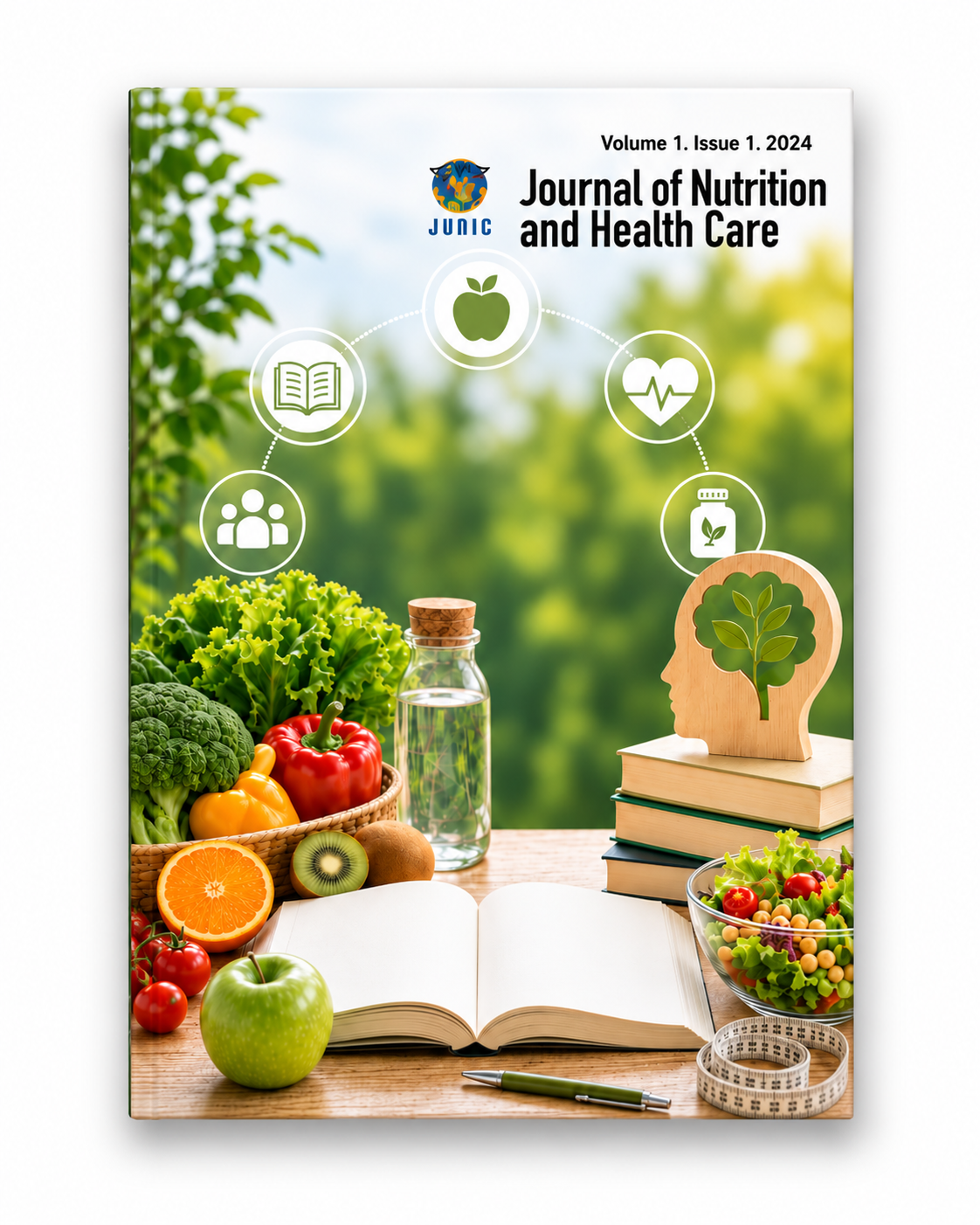
Journal Information
p-ISSN: 3062-9071
e-ISSN: 3062-9055
Language: English
Access: Open Access
Frequency: March & September
Peer Review: Double-Anonymous
Published by
CV. Professorline Publisher
Indonesia
Indonesia
Visitors
Authors are invited to submit original and high-quality scholarly manuscripts to Journal of Nutrition and Health Care (JUNIC). Manuscripts should demonstrate a clear contribution to nutrition science, clinical nutrition, public health nutrition, nutritional biochemistry, food systems, or sustainable nutrition and must comply with the journal's scientific, ethical, editorial, and manuscript preparation requirements.
Manuscripts submitted to JUNIC must present original scholarly work that has not been published previously and is not simultaneously under consideration by another journal.
Submissions should demonstrate a clear contribution within one or more of the journal's principal areas: Clinical Nutrition and Metabolism, Public Health and Life-Course Nutrition, Nutritional Biochemistry, Functional Foods and Precision Nutrition, or Food Systems, Nutrition Policy and Sustainable Nutrition.
Interdisciplinary health research may be considered when nutrition constitutes a clear and substantial component of the research question, exposure, intervention, mechanism, outcome, or policy analysis.
JUNIC primarily considers:
JUNIC applies a double-anonymous peer review process. Manuscripts submitted for review must not contain author names, affiliations, acknowledgements, institutional identifiers, or other information that directly identifies the authors.
Full author names, affiliations, countries, email addresses, and ORCID identifiers should be entered separately in the OJS metadata.
Manuscripts should be submitted in an editable word-processing format and prepared according to the official JUNIC manuscript template where provided.
Original research articles should generally include:
The title should be concise, specific, scientifically informative, and accurately reflect the principal nutritional exposure, intervention, population, outcome, mechanism, or research question.
Complete author information must be entered through OJS, including full name, institutional affiliation, country, email address, and ORCID identifier where available.
The abstract should normally contain approximately 150–250 words and clearly summarize the background, objective, methods, principal findings, and conclusion of the study.
Authors should provide 3–6 keywords that accurately represent the principal nutritional concepts, population, exposure, intervention, outcome, or methodology of the study.
The Introduction should establish the scientific and health context of the study, explain the research problem, summarize relevant evidence, identify the knowledge gap, state the research objective or hypothesis, and clearly explain the scientific significance and novelty of the study.
Authors should critically engage with relevant national and international scientific literature and avoid presenting previous research merely as a descriptive list.
Relevant biological, nutritional, clinical, epidemiological, behavioral, or policy mechanisms should be explained where appropriate.
The scientific background should clearly establish how the current study addresses an identified research gap or advances existing knowledge.
The Methods section should provide sufficient information to allow readers to understand, evaluate, and where appropriate reproduce the research procedures.
Authors should describe the study design, setting, population, participant selection, inclusion and exclusion criteria, sample size, nutritional assessment methods, exposures, interventions, outcome measures, laboratory procedures, data collection, and statistical or qualitative analyses where applicable.
Measurement instruments, dietary assessment methods, laboratory assays, questionnaires, and analytical tools should be sufficiently described and appropriately validated where relevant.
Statistical analyses should identify the statistical tests, software where relevant, handling of missing data, adjustment variables, effect estimates, uncertainty measures, and significance criteria where appropriate.
Results should be presented clearly, logically, and objectively and should correspond directly to the study objectives, research questions, or hypotheses.
Relevant numerical findings should be reported with appropriate measures such as effect estimates, confidence intervals, variability, statistical significance, or other indicators appropriate to the study design.
The Discussion should interpret the findings in relation to biological plausibility, nutritional mechanisms, clinical relevance, public health implications, existing scientific evidence, and the limitations of the study.
Authors should clearly explain how the findings advance knowledge rather than merely restating the results.
The Conclusion should directly reflect the principal findings of the study and clearly state their scientific, nutritional, clinical, public health, or policy significance.
Conclusions should not extend beyond the evidence generated by the study. Causal statements should only be made when supported by an appropriate research design and analysis.
Study limitations and recommendations for future research may also be included.
Authors should provide the following information where applicable:
Authors remain fully responsible for the accuracy, authenticity, originality, ethical compliance, and scientific interpretation of all content submitted to JUNIC.
Tables and figures should be scientifically relevant, clearly presented, appropriately numbered, and referred to in the manuscript text.
Units of measurement, abbreviations, statistical indicators, sample sizes, and explanatory notes should be clearly defined.
Images must not be manipulated in a manner that changes, obscures, enhances, or misrepresents the scientific meaning of the original data.
Authors should avoid unnecessary duplication of the same data in text, tables, and figures.
References should be relevant, scientifically credible, and sufficient to establish the current evidence base and scientific context of the manuscript.
Authors are encouraged to engage with recent peer-reviewed international literature together with important foundational sources where scientifically appropriate.
Unnecessary self-citation, citation exchange, coercive citation, or other forms of citation manipulation should be avoided.
Digital Object Identifiers (DOIs) should be provided whenever available, and authors are responsible for verifying the accuracy of all references.
Reference formatting should follow the style specified in the official JUNIC manuscript template.
All submissions undergo initial editorial screening for relevance to the journal's scope, originality, scientific contribution, methodological quality, research ethics, reporting quality, and compliance with submission requirements.
Manuscripts that successfully pass initial screening may proceed to double-anonymous peer review by at least two independent reviewers.
Authors receiving a revision decision should respond carefully to all reviewer and editor comments and provide a clear point-by-point response describing the revisions made.
Submission of a revised manuscript does not guarantee acceptance. Final publication decisions remain the responsibility of the editorial team.
Following formal acceptance, manuscripts may undergo copyediting, scientific and metadata verification, reference checking, layout preparation, proofreading, and other production procedures before publication.
The applicable Article Processing Charge is governed by the JUNIC Journal Policies and is independent of peer-review and editorial decision-making.
Authors may be asked to review publication proofs before final publication. Published articles are made openly accessible in accordance with JUNIC's Open Access and CC BY 4.0 policies.
