Caregiver Knowledge and Attitudes toward Stunting Prevention in Indonesia
A Secondary Analysis of SSGI 2024
DOI:
https://doi.org/10.62012/ppb7ar08Keywords:
Caregiver Knowledge, Attitude, Stunting Prevention, SSGI 2024, Child Nutrition, IndonesiaAbstract
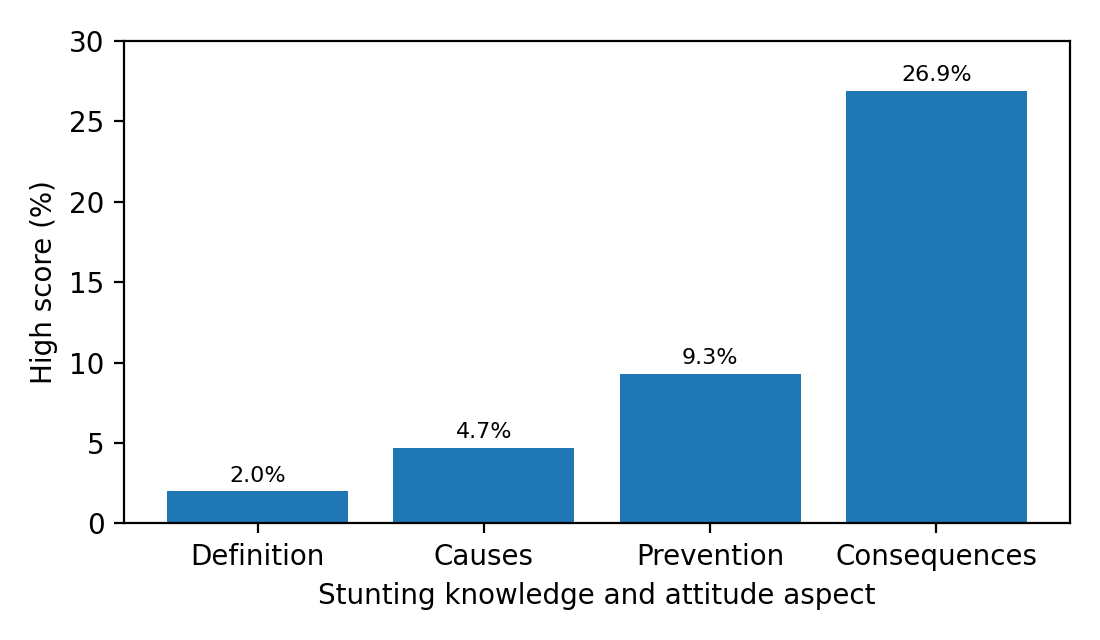
Stunting prevention requires not only nutrition-specific and nutrition-sensitive interventions but also adequate caregiver knowledge and supportive attitudes toward child growth, feeding, infection prevention, and maternal health. This article describes caregiver knowledge and attitudes toward stunting prevention in Indonesia using secondary aggregate data from the 2024 Indonesian Nutritional Status Survey (SSGI 2024). A descriptive secondary analysis was applied to publicly available SSGI 2024 tables on caregiver knowledge and attitudes about stunting. The analysis focused on four aspects: definition, causes, prevention, and consequences of stunting, as well as the composite high/good score across all aspects. SSGI 2024 assessed the main caregivers of children under five, most of whom were mothers. Nationally, the proportion of respondents with high scores was 2.0% for the definition of stunting, 4.7% for causes, 9.3% for prevention, and 26.9% for consequences. The composite high/good score across all stunting aspects was 1.7%, showing that comprehensive knowledge and attitudes remained limited. By characteristics, the composite high/good score was higher among female respondents than male respondents and varied by age group. These findings indicate that caregiver literacy about stunting prevention remains a major challenge despite national progress in reducing stunting prevalence. Strengthening caregiver-centered nutrition education, counseling quality, and community-based communication is necessary to improve stunting prevention practices in Indonesia.
Downloads
References
[1] Kementerian Kesehatan Republik Indonesia, Survei Status Gizi Indonesia 2024 dalam Angka. Jakarta, Indonesia: Kementerian Kesehatan RI, 2025.
[2] UNICEF Indonesia, Update Gizi Indonesia, Jilid 6: April-Juni 2025. Jakarta, Indonesia: United Nations Children's Fund, 2025.
[3] World Health Organization, WHO Child Growth Standards: Length/Height-for-Age, Weight-for-Age, Weight-for-Length, Weight-for-Height and Body Mass Index-for-Age: Methods and Development. Geneva, Switzerland: WHO, 2006.
[4] UNICEF, UNICEF Nutrition Strategy 2020–2030: Nutrition, for Every Child. New York, NY, USA: UNICEF, 2020.
[5] UNICEF, WHO, and World Bank Group, Levels and Trends in Child Malnutrition: UNICEF/WHO/World Bank Group Joint Child Malnutrition Estimates, 2025 Edition. New York, NY, USA: UNICEF, 2025.
[6] World Health Organization, Guideline for Complementary Feeding of Infants and Young Children 6–23 Months of Age. Geneva, Switzerland: WHO, 2023.
[7] World Health Organization, Nutrition Action in Schools: A Review of the Evidence Related to the Nutrition-Friendly Schools Initiative. Geneva, Switzerland: WHO, 2020.
[8] UNICEF Indonesia, Formative Evaluation of the National Strategy to Accelerate Stunting Prevention. Jakarta, Indonesia: UNICEF Indonesia, 2024.
[9] Sekretariat Wakil Presiden Republik Indonesia, National Strategy to Accelerate Stunting Prevention 2018–2024. Jakarta, Indonesia: Sekretariat Wakil Presiden RI, 2018.
[10] UNICEF Indonesia, Ministry of National Development Planning/Bappenas, and Groupe-conseil Baastel, Formative Evaluation of the National Strategy to Accelerate Stunting Prevention in Indonesia 2018–2024. Jakarta, Indonesia: UNICEF Indonesia, 2024.
[11] R. E. Black et al., “Maternal and child undernutrition and overweight in low-income and middle-income countries,” The Lancet, vol. 382, no. 9890, pp. 427–451, 2013.
[12] C. G. Victora et al., “Revisiting maternal and child undernutrition in low-income and middle-income countries: Variable progress towards an unfinished agenda,” The Lancet, vol. 397, no. 10282, pp. 1388–1399, 2021.
[13] Z. A. Bhutta et al., “Evidence-based interventions for improvement of maternal and child nutrition: What can be done and at what cost?,” The Lancet, vol. 382, no. 9890, pp. 452–477, 2013.
[14] M. de Onis and F. Branca, “Childhood stunting: A global perspective,” Maternal & Child Nutrition, vol. 12, no. S1, pp. 12–26, 2016.
[15] K. G. Dewey and K. Begum, “Long-term consequences of stunting in early life,” Maternal & Child Nutrition, vol. 7, no. s3, pp. 5–18, 2011.
[16] C. P. Stewart, L. Iannotti, K. G. Dewey, K. F. Michaelsen, and A. W. Onyango, “Contextualising complementary feeding in a broader framework for stunting prevention,” Maternal & Child Nutrition, vol. 9, no. S2, pp. 27–45, 2013.
[17] T. Beal, A. Tumilowicz, A. Sutrisna, D. Izwardy, and L. M. Neufeld, “A review of child stunting determinants in Indonesia,” Maternal & Child Nutrition, vol. 14, no. 4, e12617, 2018.
[18] C. R. Titaley, I. Ariawan, D. Hapsari, A. Muasyaroh, and M. J. Dibley, “Determinants of the stunting of children under two years old in Indonesia: A multilevel analysis of the 2013 Indonesia Basic Health Survey,” Nutrients, vol. 11, no. 5, 1106, 2019.
[19] M. Torlesse, A. A. Cronin, S. K. Sebayang, and R. Nandy, “Determinants of stunting in Indonesian children: Evidence from a cross-sectional survey indicate a prominent role for the water, sanitation and hygiene sector,” Maternal & Child Nutrition, vol. 12, no. S1, pp. 24–39, 2016.
[20] H. Andriani, D. O. Wirawan, and L. A. Setiawan, “Projecting the impact of a national strategy to accelerate stunting prevention in Indonesia,” BMC Public Health, vol. 25, 2025.