School Food Environment and Child Nutrition in Indonesia
Policy Insights from UNICEF NEAT-S Assessment
DOI:
https://doi.org/10.62012/94mckd69Kata Kunci:
Child Nutrition, Healthy School, Indonesia, NEAT-S, Nutrition Policy, School Food EnvironmentAbstrak
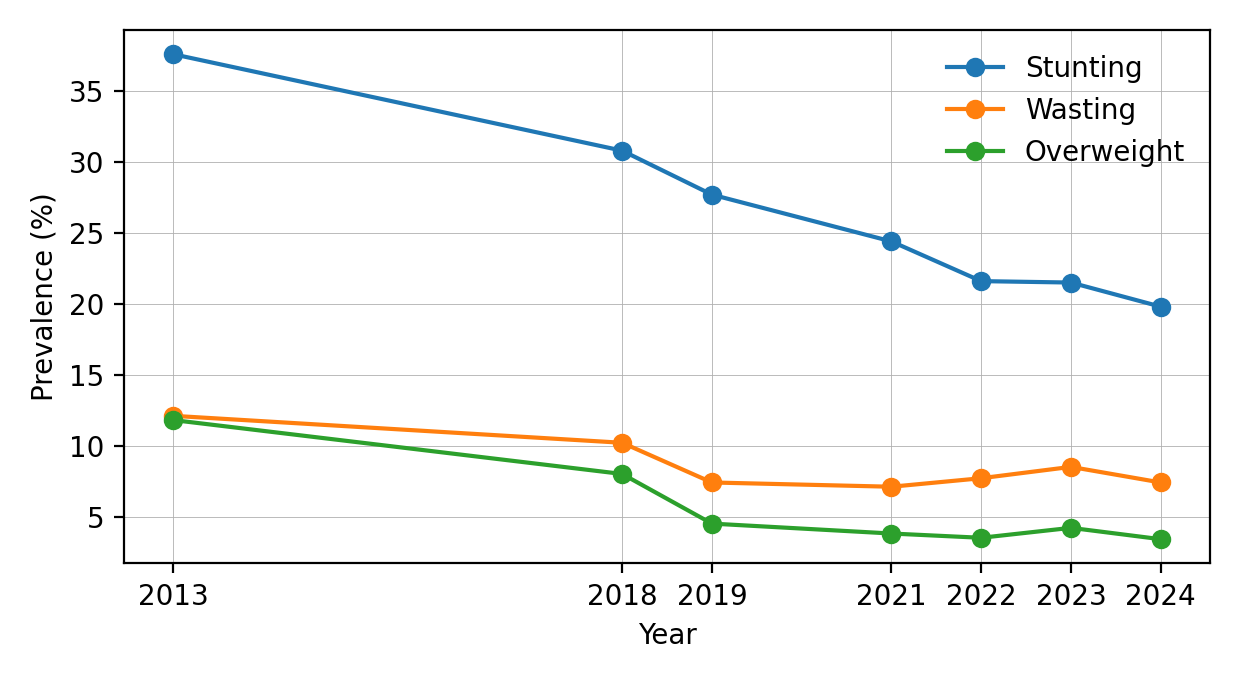
Schools are strategic settings for improving child nutrition because food availability, nutrition education, physical activity, and food marketing influence children’s daily food choices. In Indonesia, UNICEF’s recent reporting using the Nutrition Environment Assessment Toolkit for Schools (NEAT-S) highlighted important gaps in school food environments and provided policy-relevant evidence for strengthening school-based nutrition programs. This article describes policy insights on school food environments and child nutrition in Indonesia using secondary data from UNICEF Indonesia’s Update Gizi Volume 6, April–June 2025, and related school nutrition references. The study applied a secondary descriptive policy review, focusing on SSGI 2024 progress and the NEAT-S assessment conducted in approximately 270 primary schools in Java, South Sulawesi, and Papua. The findings show that Indonesia achieved sustained reductions in child malnutrition between 2013 and 2024, with stunting declining from 37.6% to 19.8%, wasting from 12.1% to 7.4%, and overweight from 11.8% to 3.4%. However, the NEAT-S summary indicated that unhealthy packaged snacks and sugar-sweetened beverages remained widely available in and around schools, while access to fruits, vegetables, and balanced cooked meals was still limited. Key policy gaps included unclear canteen guidance, weak enforcement of existing rules, infrastructure constraints, and insufficient opportunities for physical activity. Improving school food environments requires integrated policies involving school canteen standards, restrictions on unhealthy food availability and marketing, nutrition education, physical activity promotion, student participation, and alignment with the national Free Nutritious Meals programme.
Unduhan
Referensi
[1] UNICEF Indonesia, Update Gizi Indonesia, Jilid 6: April-Juni 2025. Jakarta, Indonesia: United Nations Children's Fund, 2025.
[2] UNICEF Indonesia, Nutrition Environment Assessment Toolkit for Schools (NEAT-S) in Indonesia: Identifying Barriers to Healthy School Nutrition Environments to Strengthen Policies and Programmes. Jakarta, Indonesia: UNICEF Indonesia, 2025.
[3] UNICEF East Asia and Pacific Regional Office, Nutrition Environment Assessment Toolkit for Schools. Bangkok, Thailand: UNICEF EAPRO, 2024.
[4] World Health Organization, Policies and Interventions to Create Healthy School Food Environments: WHO Guideline. Geneva, Switzerland: WHO, 2026.
[5] World Health Organization, Nutrition Action in Schools: A Review of the Evidence Related to the Nutrition-Friendly Schools Initiative. Geneva, Switzerland: WHO, 2020.
[6] World Health Organization, WHO Guidelines on Physical Activity and Sedentary Behaviour. Geneva, Switzerland: WHO, 2020.
[7] UNICEF, Child Food Poverty: Nutrition Deprivation in Early Childhood. New York, NY, USA: UNICEF, 2024.
[8] Kementerian Kesehatan Republik Indonesia, Survei Status Gizi Indonesia 2024 dalam Angka. Jakarta, Indonesia: Kementerian Kesehatan RI, 2025.
[9] Kementerian Kesehatan Republik Indonesia, Laporan Nasional Riskesdas 2018. Jakarta, Indonesia: Badan Penelitian dan Pengembangan Kesehatan, 2019.
[10] Kementerian Kesehatan Republik Indonesia, Riset Kesehatan Dasar 2013. Jakarta, Indonesia: Badan Penelitian dan Pengembangan Kesehatan, 2013.
[11] UNICEF Indonesia, Ministry of National Development Planning/Bappenas, National Nutrition Agency, and IPB University, Ministry of PPN/Bappenas, BGN, IPB University and UNICEF Launch National Centre of Excellence for the Free Nutritious Meals Programme. Jakarta, Indonesia: UNICEF Indonesia, 2025.
[12] D. Colozza, A. C. Padmita, M. Ndiaye, S. N. Tarmizi, E. Widiastuti, et al., “Barriers to childhood obesity prevention in the school food environment: A qualitative study from Indonesia,” BMJ Paediatrics Open, vol. 9, no. 1, e003980, 2025, doi: 10.1136/bmjpo-2025-003980.
[13] UNICEF Indonesia, The Cost of Inaction on Childhood Obesity in Indonesia: Summary for Policymakers. Jakarta, Indonesia: UNICEF Indonesia, 2026.
[14] H. Khusun et al., “Breakfast consumption and quality of macro- and micronutrient intake in Indonesia: A study from the Indonesian Food Barometer,” Nutrients, vol. 15, no. 17, 3792, 2023, doi: 10.3390/nu15173792.
[15] I. R. Ikrima, P. E. Giriwono, and W. P. Rahayu, “Pemahaman dan penerimaan label gizi front of pack produk snack oleh siswa SMA di Depok,” Jurnal Mutu Pangan, vol. 10, pp. 42–53, 2023.
[16] F. S. Lestiyana and N. R. Maulida, “Peningkatan pengetahuan, sikap, dan perilaku pencegahan gizi lebih melalui edutainment Ceritakan Gizi Serukan Sehat pada remaja di sekolah,” Journal of Nutrition College, vol. 14, no. 3, pp. 282–293, 2025, doi: 10.14710/jnc.v14i3.48009.
[17] T. S. Wijayanti, A. Fayasari, and T. A. Khasanah, “Permainan edukasi ular tangga meningkatkan pengetahuan dan konsumsi sayur buah pada remaja di Jakarta Selatan,” Journal of Nutrition College, vol. 10, no. 1, pp. 18–25, 2021.
[18] I. Yuliana, I. P. Sari, and F. Febry, “Peningkatan keterampilan mahasiswa dalam membaca label informasi nilai gizi menggunakan media booklet digital,” Jurnal PKM: Pengabdian Kepada Masyarakat, vol. 6, no. 3, pp. 312–318, 2023.
[19] I. J. Guo, A. C. Padmita, M. Matsuzaki, et al., “The use of social media to promote unhealthy food and beverage consumption among Indonesian children,” BMC Nutrition, vol. 11, no. 57, 2025, doi: 10.1186/s40795-025-01040-2.
[20] FAO, IFAD, UNICEF, WFP, and WHO, The State of Food Security and Nutrition in the World 2025. Rome, Italy: FAO, 2025.